Cuba Girds for Invasion as Trump Launches Raúl Castro Indictment Amid Punishing Blockade
*Drop Site’s journalism is free to read because thousands of readers choose to fund it. If our work matters to you, [please consider making a tax-deductible donation today.](https://givebutter.com/dsn-substack)*
[SUPPORT DROP SITE - DONATE TODAY](https://givebutter.com/support-dropsite)
[](https://substackcdn.com/image/fetch/$s_!Aymu!,f_auto,q_auto:good,fl_progressive:steep/https%3A%2F%2Fsubstack-post-media.s3.amazonaws.com%2Fpublic%2Fimages%2F7d7b250c-2195-49ed-b251-574e10389fc0_3643x2655.jpeg)
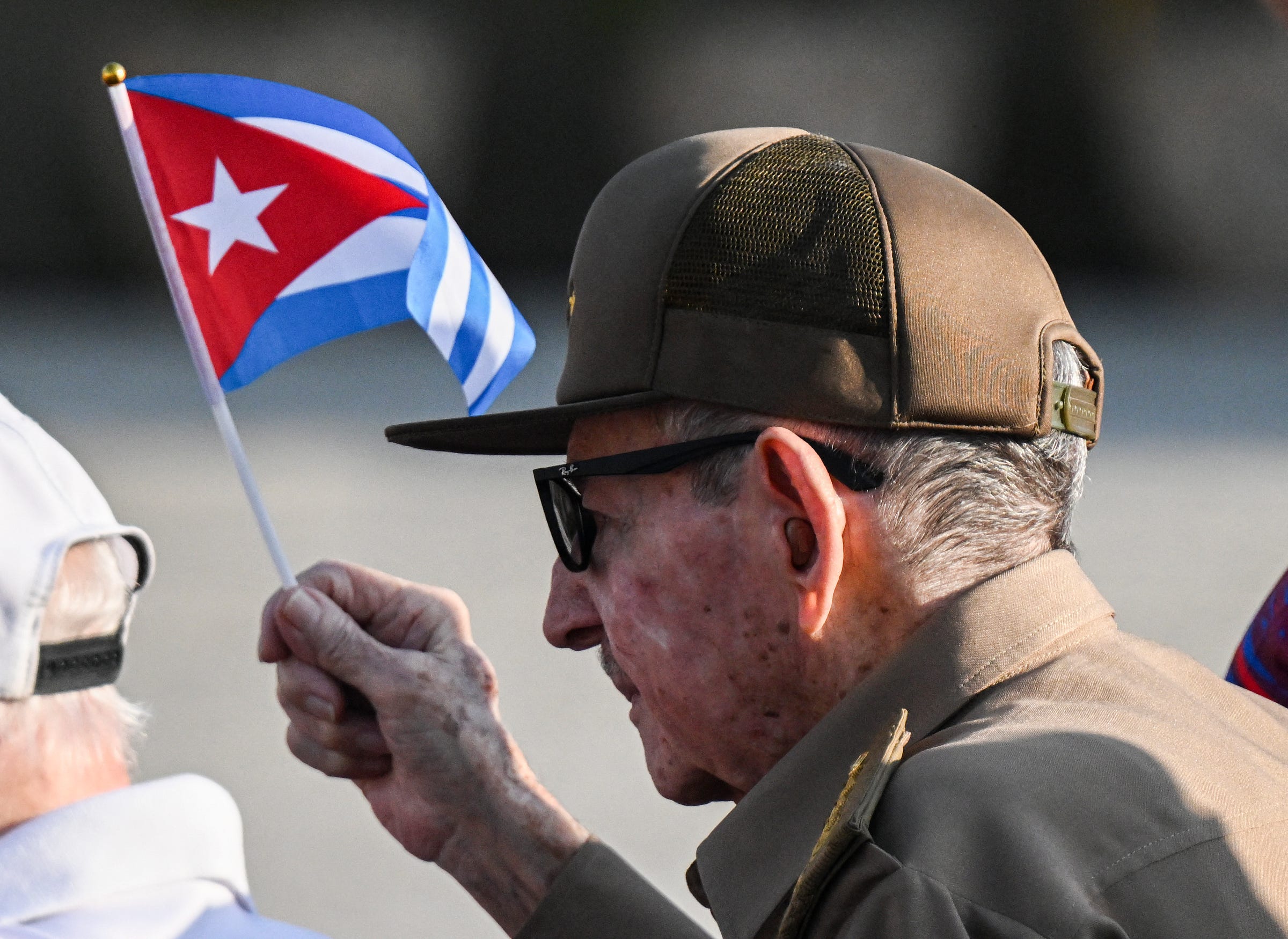
Cuba’s former President Raul Castro holds a Cuban national flag as he attends a May Day rally marking International Workers’ Day in Havana on May 1, 2026. Photo by YAMIL LAGE / AFP via Getty Images.
Over the weekend, the U.S. leaked “intelligence” to the news organization Axios claiming that Cuba had obtained some 300 Iranian drones and was making plans to attack the United States. Further down in the Axios article, the reporting clarified that the plans only existed in case of a United States attack. But the article served its purpose, and was [shared](https://x.com/RepCarlos/status/2056166131371528379) by Cuban-American politicians in South Florida as a rationale to launch a war.
On Wednesday, the U.S. Department of Justice is expected to indict the 94-year-old Raúl Castro, prompting fears of a Venezuela-like scenario via leadership decapitation. The U.S. is reportedly charging the former president in connection with the downing of two planes carrying “Brothers to the Rescue” anti-government activists in exile, killing four, back in 1996. The incident was the culmination of months of provocations, with regular incursions into Cuban airspace by Brothers to the Rescue planes.
There are many signs the situation Trump has imposed on Cuba are coming to a head. Earlier this month, the U.S. [imposed](https://www.aljazeera.com/news/2026/5/7/us-issues-new-cuba-sanctions-as-un-experts-warn-of-energy-starvation) yet another set of sanctions on the country that UN experts warned risk triggering the “energy starvation” of the island nation. [Protests have flared in recent days,](https://www.reuters.com/business/energy/cuba-has-run-out-diesel-fuel-oil-amid-us-oil-blockade-minister-says-2026-05-14/) as frustration with the collapsing economic condition has been aimed at the government—the precise goal the U.S. has been pursuing with its policy of immiseration. And reports [indicate](https://www.cnn.com/2026/05/10/americas/us-spy-flights-cuba-latam-intl) that the number of U.S. military surveillance flights taking place near the island have skyrocketed in recent weeks, raising fears of an impending operation.
Drop Site is free to read. Make sure you don’t miss a post:
The Cuban government has survived decades of enmity from the United States, both overt and covert. The Brothers to the Rescue planes, in fact, were contracted by José Basulto, a [self-confessed CIA operative](https://www.latinamericanstudies.org/exile/basulto-testifies.htm) who admitted to engaging in terrorist activities aimed at overthrowing the Cuban government. Cuba had regularly approached the U.S. via diplomatic channels to stop the flights but the Federal Aviation Administration (FAA) took corrective action only after the downing of the two planes. According to [declassified documents](https://nsarchive.gwu.edu/briefing-book/cuba/2026-05-19/cuba-declassified-records-brothers-rescue-shootdown) published by the National Security Archive, the White House was aware of the danger represented by these provocations, warning of a “worst case scenario” that eventually came to fruition.
Trump’s recent threats to “take” Cuba, however, coupled with the recent loss of energy supplies from Venezuela and the Castro indictment, may mark the most serious threat to the country’s independence since its 1959 revolution.
In an interview with Drop Site News in April, Gerardo Hernández Nordelo—who was himself imprisoned for 16 years in the U.S. for involvement in espionage work aimed at infiltrating radical Cuban exile groups, including those behind the “Brothers to the Rescue” operations—questioned the role played by hardline factions in Miami in developing U.S. policy towards Cuba, especially Secretary of State Marco Rubio. Hernández argued that they portrayed a biased and inaccurate picture of Cuban society and that their interests ultimately run contrary to those of the broader U.S. population.
“If the United States listens to that small group of advisors who spread misinformation about what is really happening in Cuba, they are destined to fail,” he said. “It would be a massacre that would not be good for any of the people.”
A conventional war with the U.S. military would inevitably be lopsided: Years of blockade and the loss of the Soviet Union as a defense partner at the end of the Cold War have severely degraded the official Cuban military. A recent [analysis](https://sofrep.com/news/cubas-defense-posture-and-special-forces/) by the U.S. military publication SOFREP assessed that Cuba today maintains less than two dozen serviceable military aircraft—mostly holdovers from the Soviet-era—along with similarly small and outdated naval and anti-aircraft capabilities.
Groups such as the Center for Strategic and International Studies maintain that both Russia and China still maintain signals intelligence installations on Cuban soil that Washington has [denounced](https://www.nytimes.com/2026/03/24/us/politics/cuba-russia-china.html) for being used for spying on the U.S., but concrete military assistance to Havana from either country is believed to be limited.
Cuba does not publicize the size of its armed forces. But its standing army has been greatly reduced over the last decade as the country has endured forced austerity under sanctions. The Cuban military is estimated to have tens of thousands of active duty soldiers and reservists, but their state of readiness and access to equipment has been impacted by years of economic breakdown in the country that would impede their ability to directly face off against an invasion.
Cuba’s elite special forces units, known as the Avispas Negras, or “Black Wasps,” enjoy better training and weaponry and could pose a threat to an invading force. But their numbers are limited—nearly three dozen of the specially trained commandos were also [killed](https://chimpreports.com/32-cuban-special-forces-killed-in-maduros-capture/) in Venezuela during the U.S. operation to capture Nicolás Maduro.
Asymmetric Warfare
------------------
This asymmetry of power does not mean that Cuba is defenseless, however. Faced with the reality of a hostile, wealthy, and powerful adversary just 90 miles from its coastline, the Cuban government has embraced a doctrine of asymmetrical warfare—drawing on its own population as a form of strategic depth to resist an invasion.
“Foreign aggression, no matter where it comes from, would only unite the people of Cuba,” Gerardo Hernández Nordelo told Drop Site News. Hernández, who is now national coordinator of the Committees for the Defense of the Revolution. “Even those who do not yet agree with this government, those who complain about the scarcities, those who criticize, would unite to defend the sovereignty of their country.”
The Cuban defense strategy is based on a doctrine known as “People’s War,” with specific wartime roles assigned to every able-bodied adult citizen, and training provided to help wage a non-conventional popular war aimed at wearing out an adversary. The country has organized eleven “National Defense Day” exercises aimed at promoting this doctrine and preparing to mobilize Cuban society as a whole for a potential military conflict. Concern over a potential U.S. operation has grown so large that Cuba’s Civil Defense recently published the “Family guide for protection against military aggression” that includes first-aid tips to advice on how to avoid suspicious artifacts.
Despite sharp divisions in Cuban society, the government is still believed to enjoy the deep loyalty of the armed forces, while running a far more consolidated ruling system than existed in Venezuela. These factors could complicate any U.S. military operation—ranging from an attempted decapitation of the system to an outright invasion of the island—while risking triggering an insurgency by powerful elements of society that remain loyal to the Cuban state.
“I don’t think there’s any doubt that the Trump administration is at least reviewing military action in Cuba as an option,” said Daniel DePetris, a fellow at the Defense Priorities think tank, told Drop Site. “As the war in Iran has shown, boasting a military advantage doesn’t necessarily translate into strategic victory.”
Many pro-government Cubans have also expressed willingness to resist a military occupation of the country—potentially complicating plans by Trump to enact a regime change by force in Havana.
“Cuba poses no threat to either the government or the people of the United States [but] if there is one word that has been erased from the Cuban vocabulary, it is precisely the word ‘surrender,’ there will be no surrender here; no one is going to come here and plant an American boot on our soil and tell us what to do in our own country,” Lizara Corona, a member of one of Cuba’s volunteer civilian militias from the Diez de Octubre neighborhood, told Drop Site News in an interview in Havana in April.
Corona had just finished celebrating—alongside thousands of other militia members in Havana—the anniversary of the proclamation of the socialist character of the Cuban Revolution. The celebration took place at the very same site in the Vedado neighborhood of the city where Fidel Castro had made the proclamation 65 years earlier during a funeral service for victims of U.S. bombings of Cuban airfields—events that preceded the failed 1961 CIA-sponsored Bay of Pigs invasion of the country.
Speaking at the event, dressed in dark green fatigues, Cuban President Miguel Díaz-Canel drew parallels between the Cuban Revolution’s resistance to U.S. imperialism in 1961 and the island’s current standoff with Washington—while issuing a defiant message indicating that the government is at least preparing for the possibility of an armed confrontation. “The moment is extremely challenging and calls upon us once again, as on that April 16, 1961, to be ready to face serious threats, including military aggression,” Díaz-Canel told the crowd.
The Committees for the Defense of the Revolution are an institution that could theoretically play a key part in any organized resistance to a U.S. military operation, or in the aftermath of an attempted regime change or state collapse. The committees play a pivotal role in the political life of Cubans at the local level and are one of the key instruments created in the aftermath of the revolution to ensure its continuity in the face of both internal and external threats, while serving as a focal point for local organizing and mobilization.
During a visit to the Fanguito neighborhood in Havana organized by a local committee, Cubans who spoke with Drop Site News acknowledged the very serious challenges the country is facing but also complained intensely about the economic impact of the U.S. blockade on the country.
“They have us by the neck trying to strangle us, and on top of that they criticize us for not being able to breathe,” said Hernández.
Boxes of Starlinks
------------------
The six-decade-long blockade, escalated by Trump, has led to major impacts on daily life in a country once revered in much of the world for its public services. Havana is almost completely dark at night, with its aging electrical grid reliant on fossil fuels and the little gas there is reserved for essential services like hospitals. The Cuban government has reported that the medical system has been forced to postpone surgeries for over 100,000 patients, including 12,000 children.
A recent study by the Center for Economic and Policy Research [found](https://cepr.net/publications/us-sanctions-and-the-sharp-rise-in-infant-mortality-in-cuba/) that Cuba’s infant mortality rate—viewed as a barometer of the population’s overall health—had risen from 4 per 1,000 live births in 2018 to 9.9 in 2025—a 148% increase. The authors’ concluded that U.S. sanctions are “very likely the primary cause of the current economic and humanitarian crisis in Cuba.”
The United States in recent days has repeatedly made a public offer of $100 million of humanitarian assistance to the people of Cuba, as the island has fully exhausted its fuel reserves amid an oil blockade implemented by the same country offering the assistance.
“The decision rests with the Cuban regime to accept our offer of assistance or deny critical living-saving aid and ultimately be accountable to the Cuban people for standing in the way of critical assistance,” a statement from the State Department read on Thursday, reiterating a message offered publicly by Rubio.
Two sources with knowledge of the American offer, however, say that it amounts largely to—and is contingent upon—the shipment of millions of Starlink devices to the island. The statement on Thursday alluded to the offer, indicating that the U.S. aid included “support for free and fast satellite internet and $100 million in direct humanitarian assistance.” The [Spanish-language news agency EFE](https://efe.com/mundo/2026-04-21/estados-unidos-reunion-cuba-internet-starlink/) reported that U.S. officials initially pressed Cuba to begin accepting Starlink units in April; the new $100 million offer is a way to push the issue forward.
While U.S. officials maintain that the offer of Starlink equipment is aimed at breaking the state’s monopoly on internet service and expanding access, the same equipment formed part of the destabilization strategy ahead of the attack on Iran, with the U.S. smuggling thousands of units into the country [according to the Wall Street Journal](https://www.wsj.com/world/middle-east/u-s-smuggled-thousands-of-starlink-terminals-into-iran-after-protest-crackdown-69a8c74f).
Asked for comment regarding the Starlink offer, a State Department official did not discuss internet access but instead said aid was dependent on distribution through the Catholic Church: “We are encouraged to see that the regime appears willing to accept the latest of our offers of assistance, but the question is whether they will let it be distributed by the Church and respected independent organizations to people in need, or require aid to be channeled through corrupt state instrumentalities and seek to steal it, like they have everything else in Cuba for seven decades.”
Cuban officials have said that they have a cooperative relationship with the Catholic Church in Cuba and do not object to such an arrangement, which puts the onus on the offer back on the United States. “If there is truly a willingness on the part of the United States government to provide aid in the amounts it announces and in full conformity with the universally recognized practices for humanitarian assistance, it will encounter no obstacles or ingratitude from Cuba, however inconsistent and paradoxical the offer may seem to a people that the United States government itself punishes collectively in a systematic and ruthless manner,” Cuban President Miguel Díaz-Canel [said on Twitter](https://x.com/DiazCanelB/status/2054992698617242111).
“The priorities are more than evident: fuels, food, and medicines,” he said. “Our experience of working with the Catholic Church is rich and productive.”
In an interview with NBC News last week, Rubio claimed the offer included “food and medicine” but that Cuba wouldn’t take it, though Cuba has consistently said they are willing to accept a serious offer of aid. “The Cuban people should know there’s $100 million of food and medicine available for them right now, and the only reason it’s not reaching the Cuban people is because of the regime,” he said.
The Cuban government has worked together with the Catholic Church via the aid group Caritas to receive U.S. humanitarian assistance, with a shipment valued at $3 million in January and a second shipment valued at $7 million announced in February. This assistance, intended for those affected by Hurricane Melissa that struck Cuba in late October 2025, has not been completely delivered. Cuban Deputy Minister of Foreign Affairs Carlos Fernández de Cossío said only 2.5 million worth of goods have actually been delivered. In the same interview with NBC, Rubio said the aid was “held up.”
Drop Site asked Caritas about progress on the distribution of the aid sent earlier this year and whether they had been approached by the U.S. with details of the $100 million package, but Caritas did not respond.
If the U.S. did deliver food and medicine, the Church would have enormous difficulty distributing it—not just due to a lack of organizational infrastructure, but the lack of gas makes shipping it around the island impossible.
“In the same manner that Cuba provides free healthcare for its people, but cannot conduct surgeries due to lack of electricity, we should expect that delivering aid to millions of people without fuel becomes extremely difficult,” said Reverend Claudia de la Cruz, executive director of The Interreligious Foundation for Community Organization (IFCO) / Pastors for Peace.
De la Cruz says her organization speaks from first-hand experience; IFCO / Pastors for Peace has over three decades of experience working in Cuba, having sent a contingent to Cuba twice in the last five months to deliver humanitarian aid.
The New York-based reverend and community leader took exception to the notion that an aid package of that size would ever be done without the support of the local government and called on the Catholic Church to “denounce” the U.S. blockade, which she called “the root cause of misery in Cuba.”
“The reality is that if the U.S. is sincere about helping the Cuban people, then collaboration with the government of the Cuban people is the only path forward,” de la Cruz told Drop Site News. “The refusal of the U.S. to do so is part of the larger plan of having the ‘offer of humanitarian aid’ be a failure or not materialize at all, to then justify further aggression.”
[Leave a comment](https://www.dropsitenews.com/p/raul-castro-indictment-cuba-starlink-trump-invasion/comments)
[Share](https://www.dropsitenews.com/p/raul-castro-indictment-cuba-starlink-trump-invasion?action=share)
---
**From [Drop Site News](https://www.dropsitenews.com/feed) via [This RSS Feed](https://www.dropsitenews.com/feed).**
[SUPPORT DROP SITE - DONATE TODAY](https://givebutter.com/support-dropsite)
[](https://substackcdn.com/image/fetch/$s_!Aymu!,f_auto,q_auto:good,fl_progressive:steep/https%3A%2F%2Fsubstack-post-media.s3.amazonaws.com%2Fpublic%2Fimages%2F7d7b250c-2195-49ed-b251-574e10389fc0_3643x2655.jpeg)
Cuba’s former President Raul Castro holds a Cuban national flag as he attends a May Day rally marking International Workers’ Day in Havana on May 1, 2026. Photo by YAMIL LAGE / AFP via Getty Images.
Over the weekend, the U.S. leaked “intelligence” to the news organization Axios claiming that Cuba had obtained some 300 Iranian drones and was making plans to attack the United States. Further down in the Axios article, the reporting clarified that the plans only existed in case of a United States attack. But the article served its purpose, and was [shared](https://x.com/RepCarlos/status/2056166131371528379) by Cuban-American politicians in South Florida as a rationale to launch a war.
On Wednesday, the U.S. Department of Justice is expected to indict the 94-year-old Raúl Castro, prompting fears of a Venezuela-like scenario via leadership decapitation. The U.S. is reportedly charging the former president in connection with the downing of two planes carrying “Brothers to the Rescue” anti-government activists in exile, killing four, back in 1996. The incident was the culmination of months of provocations, with regular incursions into Cuban airspace by Brothers to the Rescue planes.
There are many signs the situation Trump has imposed on Cuba are coming to a head. Earlier this month, the U.S. [imposed](https://www.aljazeera.com/news/2026/5/7/us-issues-new-cuba-sanctions-as-un-experts-warn-of-energy-starvation) yet another set of sanctions on the country that UN experts warned risk triggering the “energy starvation” of the island nation. [Protests have flared in recent days,](https://www.reuters.com/business/energy/cuba-has-run-out-diesel-fuel-oil-amid-us-oil-blockade-minister-says-2026-05-14/) as frustration with the collapsing economic condition has been aimed at the government—the precise goal the U.S. has been pursuing with its policy of immiseration. And reports [indicate](https://www.cnn.com/2026/05/10/americas/us-spy-flights-cuba-latam-intl) that the number of U.S. military surveillance flights taking place near the island have skyrocketed in recent weeks, raising fears of an impending operation.
Drop Site is free to read. Make sure you don’t miss a post:
The Cuban government has survived decades of enmity from the United States, both overt and covert. The Brothers to the Rescue planes, in fact, were contracted by José Basulto, a [self-confessed CIA operative](https://www.latinamericanstudies.org/exile/basulto-testifies.htm) who admitted to engaging in terrorist activities aimed at overthrowing the Cuban government. Cuba had regularly approached the U.S. via diplomatic channels to stop the flights but the Federal Aviation Administration (FAA) took corrective action only after the downing of the two planes. According to [declassified documents](https://nsarchive.gwu.edu/briefing-book/cuba/2026-05-19/cuba-declassified-records-brothers-rescue-shootdown) published by the National Security Archive, the White House was aware of the danger represented by these provocations, warning of a “worst case scenario” that eventually came to fruition.
Trump’s recent threats to “take” Cuba, however, coupled with the recent loss of energy supplies from Venezuela and the Castro indictment, may mark the most serious threat to the country’s independence since its 1959 revolution.
In an interview with Drop Site News in April, Gerardo Hernández Nordelo—who was himself imprisoned for 16 years in the U.S. for involvement in espionage work aimed at infiltrating radical Cuban exile groups, including those behind the “Brothers to the Rescue” operations—questioned the role played by hardline factions in Miami in developing U.S. policy towards Cuba, especially Secretary of State Marco Rubio. Hernández argued that they portrayed a biased and inaccurate picture of Cuban society and that their interests ultimately run contrary to those of the broader U.S. population.
“If the United States listens to that small group of advisors who spread misinformation about what is really happening in Cuba, they are destined to fail,” he said. “It would be a massacre that would not be good for any of the people.”
A conventional war with the U.S. military would inevitably be lopsided: Years of blockade and the loss of the Soviet Union as a defense partner at the end of the Cold War have severely degraded the official Cuban military. A recent [analysis](https://sofrep.com/news/cubas-defense-posture-and-special-forces/) by the U.S. military publication SOFREP assessed that Cuba today maintains less than two dozen serviceable military aircraft—mostly holdovers from the Soviet-era—along with similarly small and outdated naval and anti-aircraft capabilities.
Groups such as the Center for Strategic and International Studies maintain that both Russia and China still maintain signals intelligence installations on Cuban soil that Washington has [denounced](https://www.nytimes.com/2026/03/24/us/politics/cuba-russia-china.html) for being used for spying on the U.S., but concrete military assistance to Havana from either country is believed to be limited.
Cuba does not publicize the size of its armed forces. But its standing army has been greatly reduced over the last decade as the country has endured forced austerity under sanctions. The Cuban military is estimated to have tens of thousands of active duty soldiers and reservists, but their state of readiness and access to equipment has been impacted by years of economic breakdown in the country that would impede their ability to directly face off against an invasion.
Cuba’s elite special forces units, known as the Avispas Negras, or “Black Wasps,” enjoy better training and weaponry and could pose a threat to an invading force. But their numbers are limited—nearly three dozen of the specially trained commandos were also [killed](https://chimpreports.com/32-cuban-special-forces-killed-in-maduros-capture/) in Venezuela during the U.S. operation to capture Nicolás Maduro.
Asymmetric Warfare
------------------
This asymmetry of power does not mean that Cuba is defenseless, however. Faced with the reality of a hostile, wealthy, and powerful adversary just 90 miles from its coastline, the Cuban government has embraced a doctrine of asymmetrical warfare—drawing on its own population as a form of strategic depth to resist an invasion.
“Foreign aggression, no matter where it comes from, would only unite the people of Cuba,” Gerardo Hernández Nordelo told Drop Site News. Hernández, who is now national coordinator of the Committees for the Defense of the Revolution. “Even those who do not yet agree with this government, those who complain about the scarcities, those who criticize, would unite to defend the sovereignty of their country.”
The Cuban defense strategy is based on a doctrine known as “People’s War,” with specific wartime roles assigned to every able-bodied adult citizen, and training provided to help wage a non-conventional popular war aimed at wearing out an adversary. The country has organized eleven “National Defense Day” exercises aimed at promoting this doctrine and preparing to mobilize Cuban society as a whole for a potential military conflict. Concern over a potential U.S. operation has grown so large that Cuba’s Civil Defense recently published the “Family guide for protection against military aggression” that includes first-aid tips to advice on how to avoid suspicious artifacts.
Despite sharp divisions in Cuban society, the government is still believed to enjoy the deep loyalty of the armed forces, while running a far more consolidated ruling system than existed in Venezuela. These factors could complicate any U.S. military operation—ranging from an attempted decapitation of the system to an outright invasion of the island—while risking triggering an insurgency by powerful elements of society that remain loyal to the Cuban state.
“I don’t think there’s any doubt that the Trump administration is at least reviewing military action in Cuba as an option,” said Daniel DePetris, a fellow at the Defense Priorities think tank, told Drop Site. “As the war in Iran has shown, boasting a military advantage doesn’t necessarily translate into strategic victory.”
Many pro-government Cubans have also expressed willingness to resist a military occupation of the country—potentially complicating plans by Trump to enact a regime change by force in Havana.
“Cuba poses no threat to either the government or the people of the United States [but] if there is one word that has been erased from the Cuban vocabulary, it is precisely the word ‘surrender,’ there will be no surrender here; no one is going to come here and plant an American boot on our soil and tell us what to do in our own country,” Lizara Corona, a member of one of Cuba’s volunteer civilian militias from the Diez de Octubre neighborhood, told Drop Site News in an interview in Havana in April.
Corona had just finished celebrating—alongside thousands of other militia members in Havana—the anniversary of the proclamation of the socialist character of the Cuban Revolution. The celebration took place at the very same site in the Vedado neighborhood of the city where Fidel Castro had made the proclamation 65 years earlier during a funeral service for victims of U.S. bombings of Cuban airfields—events that preceded the failed 1961 CIA-sponsored Bay of Pigs invasion of the country.
Speaking at the event, dressed in dark green fatigues, Cuban President Miguel Díaz-Canel drew parallels between the Cuban Revolution’s resistance to U.S. imperialism in 1961 and the island’s current standoff with Washington—while issuing a defiant message indicating that the government is at least preparing for the possibility of an armed confrontation. “The moment is extremely challenging and calls upon us once again, as on that April 16, 1961, to be ready to face serious threats, including military aggression,” Díaz-Canel told the crowd.
The Committees for the Defense of the Revolution are an institution that could theoretically play a key part in any organized resistance to a U.S. military operation, or in the aftermath of an attempted regime change or state collapse. The committees play a pivotal role in the political life of Cubans at the local level and are one of the key instruments created in the aftermath of the revolution to ensure its continuity in the face of both internal and external threats, while serving as a focal point for local organizing and mobilization.
During a visit to the Fanguito neighborhood in Havana organized by a local committee, Cubans who spoke with Drop Site News acknowledged the very serious challenges the country is facing but also complained intensely about the economic impact of the U.S. blockade on the country.
“They have us by the neck trying to strangle us, and on top of that they criticize us for not being able to breathe,” said Hernández.
Boxes of Starlinks
------------------
The six-decade-long blockade, escalated by Trump, has led to major impacts on daily life in a country once revered in much of the world for its public services. Havana is almost completely dark at night, with its aging electrical grid reliant on fossil fuels and the little gas there is reserved for essential services like hospitals. The Cuban government has reported that the medical system has been forced to postpone surgeries for over 100,000 patients, including 12,000 children.
A recent study by the Center for Economic and Policy Research [found](https://cepr.net/publications/us-sanctions-and-the-sharp-rise-in-infant-mortality-in-cuba/) that Cuba’s infant mortality rate—viewed as a barometer of the population’s overall health—had risen from 4 per 1,000 live births in 2018 to 9.9 in 2025—a 148% increase. The authors’ concluded that U.S. sanctions are “very likely the primary cause of the current economic and humanitarian crisis in Cuba.”
The United States in recent days has repeatedly made a public offer of $100 million of humanitarian assistance to the people of Cuba, as the island has fully exhausted its fuel reserves amid an oil blockade implemented by the same country offering the assistance.
“The decision rests with the Cuban regime to accept our offer of assistance or deny critical living-saving aid and ultimately be accountable to the Cuban people for standing in the way of critical assistance,” a statement from the State Department read on Thursday, reiterating a message offered publicly by Rubio.
Two sources with knowledge of the American offer, however, say that it amounts largely to—and is contingent upon—the shipment of millions of Starlink devices to the island. The statement on Thursday alluded to the offer, indicating that the U.S. aid included “support for free and fast satellite internet and $100 million in direct humanitarian assistance.” The [Spanish-language news agency EFE](https://efe.com/mundo/2026-04-21/estados-unidos-reunion-cuba-internet-starlink/) reported that U.S. officials initially pressed Cuba to begin accepting Starlink units in April; the new $100 million offer is a way to push the issue forward.
While U.S. officials maintain that the offer of Starlink equipment is aimed at breaking the state’s monopoly on internet service and expanding access, the same equipment formed part of the destabilization strategy ahead of the attack on Iran, with the U.S. smuggling thousands of units into the country [according to the Wall Street Journal](https://www.wsj.com/world/middle-east/u-s-smuggled-thousands-of-starlink-terminals-into-iran-after-protest-crackdown-69a8c74f).
Asked for comment regarding the Starlink offer, a State Department official did not discuss internet access but instead said aid was dependent on distribution through the Catholic Church: “We are encouraged to see that the regime appears willing to accept the latest of our offers of assistance, but the question is whether they will let it be distributed by the Church and respected independent organizations to people in need, or require aid to be channeled through corrupt state instrumentalities and seek to steal it, like they have everything else in Cuba for seven decades.”
Cuban officials have said that they have a cooperative relationship with the Catholic Church in Cuba and do not object to such an arrangement, which puts the onus on the offer back on the United States. “If there is truly a willingness on the part of the United States government to provide aid in the amounts it announces and in full conformity with the universally recognized practices for humanitarian assistance, it will encounter no obstacles or ingratitude from Cuba, however inconsistent and paradoxical the offer may seem to a people that the United States government itself punishes collectively in a systematic and ruthless manner,” Cuban President Miguel Díaz-Canel [said on Twitter](https://x.com/DiazCanelB/status/2054992698617242111).
“The priorities are more than evident: fuels, food, and medicines,” he said. “Our experience of working with the Catholic Church is rich and productive.”
In an interview with NBC News last week, Rubio claimed the offer included “food and medicine” but that Cuba wouldn’t take it, though Cuba has consistently said they are willing to accept a serious offer of aid. “The Cuban people should know there’s $100 million of food and medicine available for them right now, and the only reason it’s not reaching the Cuban people is because of the regime,” he said.
The Cuban government has worked together with the Catholic Church via the aid group Caritas to receive U.S. humanitarian assistance, with a shipment valued at $3 million in January and a second shipment valued at $7 million announced in February. This assistance, intended for those affected by Hurricane Melissa that struck Cuba in late October 2025, has not been completely delivered. Cuban Deputy Minister of Foreign Affairs Carlos Fernández de Cossío said only 2.5 million worth of goods have actually been delivered. In the same interview with NBC, Rubio said the aid was “held up.”
Drop Site asked Caritas about progress on the distribution of the aid sent earlier this year and whether they had been approached by the U.S. with details of the $100 million package, but Caritas did not respond.
If the U.S. did deliver food and medicine, the Church would have enormous difficulty distributing it—not just due to a lack of organizational infrastructure, but the lack of gas makes shipping it around the island impossible.
“In the same manner that Cuba provides free healthcare for its people, but cannot conduct surgeries due to lack of electricity, we should expect that delivering aid to millions of people without fuel becomes extremely difficult,” said Reverend Claudia de la Cruz, executive director of The Interreligious Foundation for Community Organization (IFCO) / Pastors for Peace.
De la Cruz says her organization speaks from first-hand experience; IFCO / Pastors for Peace has over three decades of experience working in Cuba, having sent a contingent to Cuba twice in the last five months to deliver humanitarian aid.
The New York-based reverend and community leader took exception to the notion that an aid package of that size would ever be done without the support of the local government and called on the Catholic Church to “denounce” the U.S. blockade, which she called “the root cause of misery in Cuba.”
“The reality is that if the U.S. is sincere about helping the Cuban people, then collaboration with the government of the Cuban people is the only path forward,” de la Cruz told Drop Site News. “The refusal of the U.S. to do so is part of the larger plan of having the ‘offer of humanitarian aid’ be a failure or not materialize at all, to then justify further aggression.”
[Leave a comment](https://www.dropsitenews.com/p/raul-castro-indictment-cuba-starlink-trump-invasion/comments)
[Share](https://www.dropsitenews.com/p/raul-castro-indictment-cuba-starlink-trump-invasion?action=share)
---
**From [Drop Site News](https://www.dropsitenews.com/feed) via [This RSS Feed](https://www.dropsitenews.com/feed).**