Notice Given to Parents: Researchers Wanted Preschool Teachers to Wear Cameras to Record Everything They Saw From a First-Person Perspective, Including The Children They Were Teaching, to Train AI.
::: spoiler First Photo Transcript
Cultivate Learning
UNIVERSITY of WASHINGTON
Parent/Guardian Permission Form: Classroom Video Recording for Early Childhood Education Research
Dear Parent or Guardian,
Your child's classroom is participating in a research study led by Dr. Gail Joseph and the Cultivate Learning team at the University of Washington. The goal of this study is to better understand children's everyday learning experiences and to develop Al tools that can help assess classroom interaction quality. We are writing to ask for your permission to include your child in this study.
**What Will Happen in the Classroom**
With your permission, your child's lead teacher may wear a small teacher-worn camera that captures the teacher's approximate first-person perspective, and/or we may place a fixed video camera in the classroom. These videos simply capture the normal interactions between teachers and children during regular classroom activities. Recordings occur during morning program hours up to 150 minutes, up to 4 visits in one month. Your child will not be asked to do anything new or different. Their daily routine will stay exactly the same.
**How Will the Video Recordings Be Used**?
The video recordings may be used for the following purposes, but not limited to:
1. **Supporting Teachers Through Coaching and Al Tools**. Videos will be used to develop and evaluate Al models for assessing classroom interaction quality. This involves multiple steps:
- **Human coding**: Trained research staff will watch and code videos using validated classroom observation tools to evaluate the quality of teacher-child interactions.
- Human-coded data from these videos will be used to train and improve Al models so they can more accurately identify high-quality teaching practices over time. Al tools will also analyze the same recordings to generate codes and justifications. Only the research team uses these coded videos to train secure, private Al models.
- **Teaching summary**: After all recording sessions and coding are complete, teachers will receive a written observation summary based on human-coded scores, reviewed by a member of the research team.
2. **Research on Children's Learning Experiences**. Video data will be used to study how individual children experience their classroom environment, including how often they interact with teachers and the quality of those interactions. This research aims to better understand what supports positive learning outcomes for young children. This may help your child's teacher provide the best classroom experiences to nurture your child's growth and learning.
3. **Research Publications & Conference Presentations**. Short clips or images may be included in academic publications or presented at professional conferences to illustrate study findings. Children's identities will be protected whenever possible by using blurring faces and editing out the child's name in the audio.
4. **Project Demonstration Videos**. Brief clips may be used in videos that explain how the Al system works. These clips will not publicly identify your child, and will be selected with care to respect children's privacy.
5. **Restricted-Access Research Dataset**. Clips or related data may be shared in a secure, restricted research dataset to support future early childhood education research.
:::
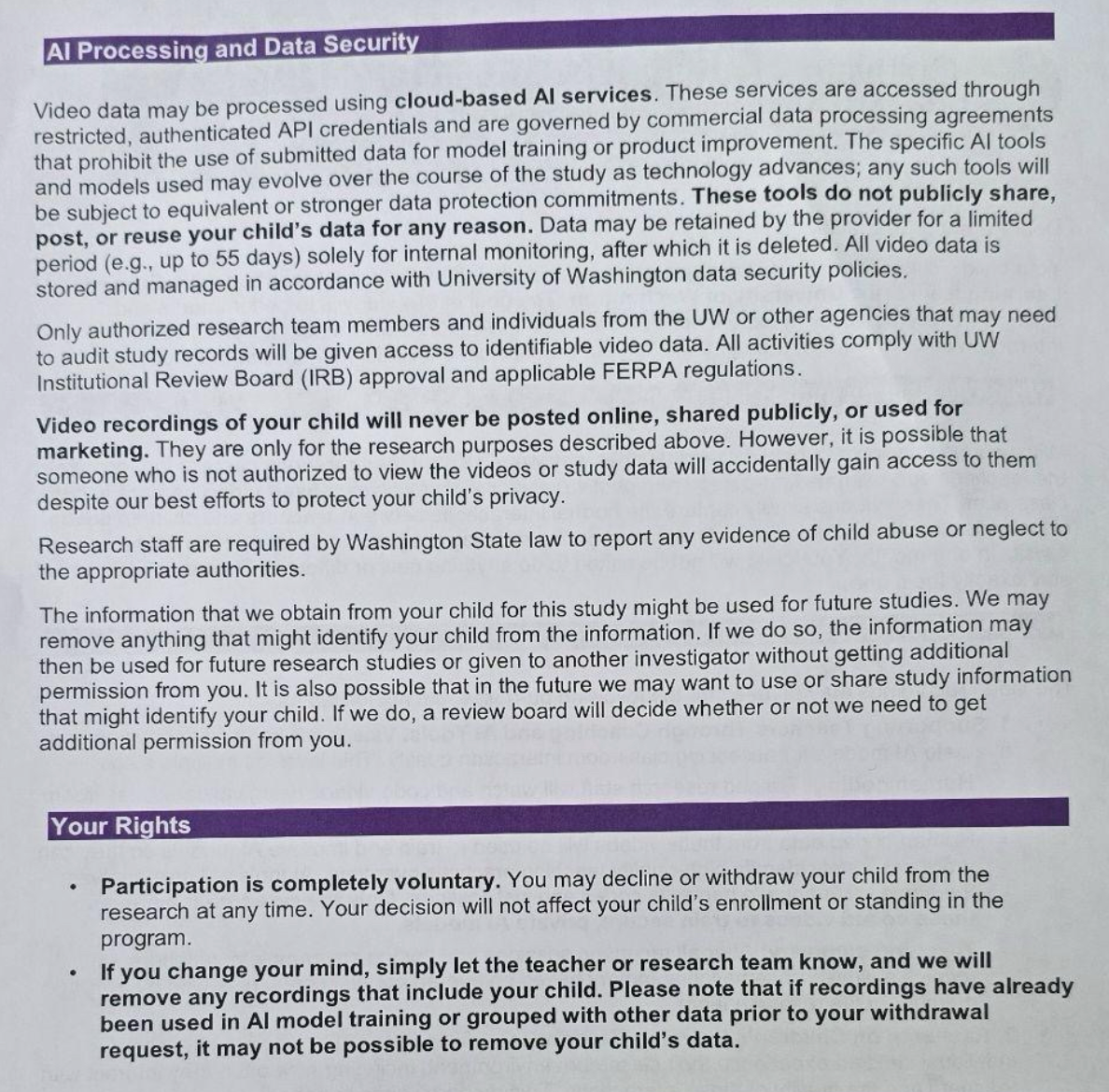
::: spoiler Second Photo Transcript
**Al Processing and Data Security**
Video data may be processed using **cloud-based Al services**. These services are accessed through restricted, authenticated API credentials and are governed by commercial data processing agreements that prohibit the use of submitted data for model training or product improvement. The specific Al tools and models used may evolve over the course of the study as technology advances; any such tools will be subject to equivalent or stronger data protection commitments. **These tools do not publicly share, post, or reuse your child's data for any reason**. Data may be retained by the provider for a limited period (e.g., up to 55 days) solely for internal monitoring, after which it is deleted. All video data is stored and managed in accordance with University of Washington data security policies.
Only authorized research team members and individuals from the UW or other agencies that may need to audit study records will be given access to identifiable video data. All activities comply with UW Institutional Review Board (IRB) approval and applicable FERPA regulations.
**Video recordings of your child will never be posted online, shared publicly, or used for marketing**. They are only for the research purposes described above. However, it is possible that someone who is not authorized to view the videos or study data will accidentally gain access to them despite our best efforts to protect your child's privacy.
Research staff are required by Washington State law to report any evidence of child abuse or neglect to the appropriate authorities.
The information that we obtain from your child for this study might be used for future studies. We may remove anything that might identify your child from the information. If we do so, the information may then be used for future research studies or given to another investigator without getting additional permission from you. It is also possible that in the future we may want to use or share study information that might identify your child. If we do, a review board will decide whether or not we need to get additional permission from you.
**Your Rights**
- **Participation is completely voluntary**. You may decline or withdraw your child from the research at any time. Your decision will not affect your child's enrollment or standing in the program.
- If you change your mind, simply let the teacher or research team know, and we will remove any recordings that include your child. Please note that if recordings have already been used in Al model training or grouped with other data prior to your withdrawal request, it may not be possible to remove your child's data**.
:::
> The document presents participation in the research as “completely voluntary.” But it is not an opt-in model. Instead, parents have to opt-out if they don’t want their children to be recorded by a teacher-worn camera and have that footage processed by AI. “You may decline or withdraw your child from the research at any time. Your decision will not affect your child’s enrollment or standing in the program,” it says.
> Jackson Holtz, assistant director of University of Washington News, told 404 Media in an email that if a parent did opt-out, that entire class would be removed from the research. “The consent process was designed so that not only could families opt out, if even a single family decided to opt out, their entire classroom would be excluded,” he wrote. The parent said, “Only through questioning teachers and school administrators did we learn the researchers would put stickers on children who opted out, but no further information was provided on whether they would still be filmed.”
> “Our initial outreach was intended to help us better understand how families would feel about a project that uses artificial intelligence to support teachers,” Holtz continued. Holtz said after that feedback, the University of Washington has stopped the research. “Given the early responses from parents, we have terminated the study and are no longer seeking participation at any site. (It is not unusual to terminate a study in the early stages as we receive feedback from community partners.) All programs are in the process of being notified that this particular study is now terminated,” he wrote.
> After 404 Media contacted the university for comment, the section of its website describing the study was taken offline.
Leak Source: [404 Media](https://www.404media.co/researchers-wanted-preschool-teachers-to-wear-cameras-to-train-ai/)— [Archive](https://archive.ph/rY1vW).
::: spoiler First Photo Transcript
Cultivate Learning
UNIVERSITY of WASHINGTON
Parent/Guardian Permission Form: Classroom Video Recording for Early Childhood Education Research
Dear Parent or Guardian,
Your child's classroom is participating in a research study led by Dr. Gail Joseph and the Cultivate Learning team at the University of Washington. The goal of this study is to better understand children's everyday learning experiences and to develop Al tools that can help assess classroom interaction quality. We are writing to ask for your permission to include your child in this study.
**What Will Happen in the Classroom**
With your permission, your child's lead teacher may wear a small teacher-worn camera that captures the teacher's approximate first-person perspective, and/or we may place a fixed video camera in the classroom. These videos simply capture the normal interactions between teachers and children during regular classroom activities. Recordings occur during morning program hours up to 150 minutes, up to 4 visits in one month. Your child will not be asked to do anything new or different. Their daily routine will stay exactly the same.
**How Will the Video Recordings Be Used**?
The video recordings may be used for the following purposes, but not limited to:
1. **Supporting Teachers Through Coaching and Al Tools**. Videos will be used to develop and evaluate Al models for assessing classroom interaction quality. This involves multiple steps:
- **Human coding**: Trained research staff will watch and code videos using validated classroom observation tools to evaluate the quality of teacher-child interactions.
- Human-coded data from these videos will be used to train and improve Al models so they can more accurately identify high-quality teaching practices over time. Al tools will also analyze the same recordings to generate codes and justifications. Only the research team uses these coded videos to train secure, private Al models.
- **Teaching summary**: After all recording sessions and coding are complete, teachers will receive a written observation summary based on human-coded scores, reviewed by a member of the research team.
2. **Research on Children's Learning Experiences**. Video data will be used to study how individual children experience their classroom environment, including how often they interact with teachers and the quality of those interactions. This research aims to better understand what supports positive learning outcomes for young children. This may help your child's teacher provide the best classroom experiences to nurture your child's growth and learning.
3. **Research Publications & Conference Presentations**. Short clips or images may be included in academic publications or presented at professional conferences to illustrate study findings. Children's identities will be protected whenever possible by using blurring faces and editing out the child's name in the audio.
4. **Project Demonstration Videos**. Brief clips may be used in videos that explain how the Al system works. These clips will not publicly identify your child, and will be selected with care to respect children's privacy.
5. **Restricted-Access Research Dataset**. Clips or related data may be shared in a secure, restricted research dataset to support future early childhood education research.
:::
::: spoiler Second Photo Transcript
**Al Processing and Data Security**
Video data may be processed using **cloud-based Al services**. These services are accessed through restricted, authenticated API credentials and are governed by commercial data processing agreements that prohibit the use of submitted data for model training or product improvement. The specific Al tools and models used may evolve over the course of the study as technology advances; any such tools will be subject to equivalent or stronger data protection commitments. **These tools do not publicly share, post, or reuse your child's data for any reason**. Data may be retained by the provider for a limited period (e.g., up to 55 days) solely for internal monitoring, after which it is deleted. All video data is stored and managed in accordance with University of Washington data security policies.
Only authorized research team members and individuals from the UW or other agencies that may need to audit study records will be given access to identifiable video data. All activities comply with UW Institutional Review Board (IRB) approval and applicable FERPA regulations.
**Video recordings of your child will never be posted online, shared publicly, or used for marketing**. They are only for the research purposes described above. However, it is possible that someone who is not authorized to view the videos or study data will accidentally gain access to them despite our best efforts to protect your child's privacy.
Research staff are required by Washington State law to report any evidence of child abuse or neglect to the appropriate authorities.
The information that we obtain from your child for this study might be used for future studies. We may remove anything that might identify your child from the information. If we do so, the information may then be used for future research studies or given to another investigator without getting additional permission from you. It is also possible that in the future we may want to use or share study information that might identify your child. If we do, a review board will decide whether or not we need to get additional permission from you.
**Your Rights**
- **Participation is completely voluntary**. You may decline or withdraw your child from the research at any time. Your decision will not affect your child's enrollment or standing in the program.
- If you change your mind, simply let the teacher or research team know, and we will remove any recordings that include your child. Please note that if recordings have already been used in Al model training or grouped with other data prior to your withdrawal request, it may not be possible to remove your child's data**.
:::
> The document presents participation in the research as “completely voluntary.” But it is not an opt-in model. Instead, parents have to opt-out if they don’t want their children to be recorded by a teacher-worn camera and have that footage processed by AI. “You may decline or withdraw your child from the research at any time. Your decision will not affect your child’s enrollment or standing in the program,” it says.
> Jackson Holtz, assistant director of University of Washington News, told 404 Media in an email that if a parent did opt-out, that entire class would be removed from the research. “The consent process was designed so that not only could families opt out, if even a single family decided to opt out, their entire classroom would be excluded,” he wrote. The parent said, “Only through questioning teachers and school administrators did we learn the researchers would put stickers on children who opted out, but no further information was provided on whether they would still be filmed.”
> “Our initial outreach was intended to help us better understand how families would feel about a project that uses artificial intelligence to support teachers,” Holtz continued. Holtz said after that feedback, the University of Washington has stopped the research. “Given the early responses from parents, we have terminated the study and are no longer seeking participation at any site. (It is not unusual to terminate a study in the early stages as we receive feedback from community partners.) All programs are in the process of being notified that this particular study is now terminated,” he wrote.
> After 404 Media contacted the university for comment, the section of its website describing the study was taken offline.
Leak Source: [404 Media](https://www.404media.co/researchers-wanted-preschool-teachers-to-wear-cameras-to-train-ai/)— [Archive](https://archive.ph/rY1vW).